

Finding bed bugs in your home is stressful enough without having to worry about filling the place with chemical sprays on top of it. The good news is that some effective ways to deal with bed bugs don’t involve chemicals at all — and if you have young children, pets, or anyone in the house with asthma or allergies, that matters.
Here’s an honest look at the natural options available, what they can realistically do, and where they fall short.
Washing and Drying on High Heat
Start here. Any bedding, clothing, or fabric items that can go in the wash should be washed at 60°C and tumble dried on a high heat setting straight away. It won’t solve the whole problem, but it removes bugs and eggs from the things closest to where you sleep — and it costs nothing extra.
Note: This should remove the bugs from the bedding but this won’t remove them if they are in the bed frame.
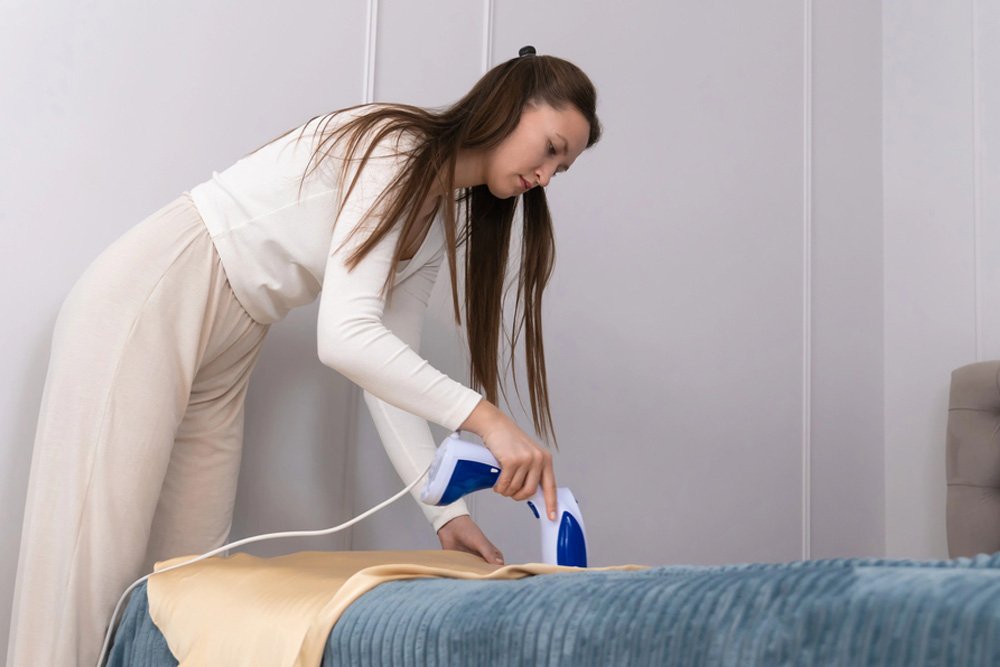
Steam Cleaning
A steam cleaner is genuinely useful for treating mattresses, furniture, and the cracks and seams where bed bugs tend to hide. The heat kills bugs and eggs on contact, and it gets into places you can’t reach with a spray or a cloth.
The catch is that steam only works on surfaces. It can’t penetrate deep inside walls, behind skirting boards, or into the internal structure of furniture. It’s a good tool to have, but on its own it won’t clear an established infestation.
Note: Again, if they are on the underside of the bed frame, it is unlikely that you will be able to remove them completely.

Essential Oils
Tea tree, lavender, and peppermint oils come up a lot in conversations about natural bed bug remedies. They can act as a mild deterrent on treated surfaces, but they won’t kill bugs, won’t touch eggs, and won’t reach the places bugs are actually living. They’re not a treatment — they’re more of a minor inconvenience to bed bugs at best.
Freezing
Bed bugs can’t survive sustained cold either. Smaller items can be sealed in bags and placed in a freezer set to at least -18°C for a few days ThermoPest to kill any bugs or eggs they might be carrying.
This is perfectly practical for individual items like bags, soft toys, or clothing you can’t wash on a high heat. It’s obviously not a solution for your mattress or your sofa, so think of it as a useful addition rather than a fix.
Diatomaceous Earth
Diatomaceous earth — or DE — is a fine natural powder made from fossilised algae. When bed bugs walk through it, the particles damage the outer layer of their bodies, causing them to dry out and die. It’s chemical-free, and food-grade versions are safe to use around people and pets.
Research has found that while DE can help reduce bed bug numbers, it works best as part of a broader approach. It can take several days to take effect, and its effectiveness drops in humid conditions or if the powder is disturbed. Terminix
It’s also slow — results can take anywhere from 7 to 17 days ZappBug — and it only works where bugs actually walk through it. Anything hiding deep inside furniture or behind walls won’t be affected.
One important practical note: always use food-grade DE and wear a mask when applying it. Pool grade and garden grade versions contain high concentrations of crystalline silica, which can be harmful if inhaled, and should never be used inside the home. MMPC
Vacuuming
Vacuuming regularly — mattress, bed frame, carpet, furniture seams — helps remove live bugs and keeps numbers down. It won’t resolve an infestation on its own, but it’s a sensible habit to maintain alongside everything else. Just make sure you dispose of the vacuum bag in an outside bin straight after.

Professional Heat Treatment
All of the above have their place, and using several of them together is always better than relying on just one. But if the infestation is already established, there’s a ceiling to what home remedies can achieve — and it’s worth being upfront about that.
Professional heat treatment belongs in this article for a straightforward reason: it’s entirely natural. No chemicals are introduced into your home. Nothing is left on your mattress, your bedding, or your children’s belongings. The treatment uses heat — and only heat — to clear the infestation.
The way it works is simple. Industrial heating equipment raises the temperature of the room to between 50°C and 60°C and holds it there long enough to kill every bed bug in the space — adults, nymphs, and eggs. Unlike chemical treatments, heat is unaffected by insecticide resistance and doesn’t rely on bugs moving through a treated surface. When the right temperature is reached and maintained, the result is complete mortality at every life stage. ThermoPest
The key difference between this and a steam cleaner is what the heat actually reaches. A steamer works on surfaces. Professional heat treatment raises the temperature of the entire room — the air, the furniture, the walls, the mattress, the skirting boards, every crack and gap where a bug might be hiding. There is nowhere for them to go. ThermoPest
When it’s done, you can walk straight back in. The room cools down, and that’s it — no residue, no smell, nothing to wait out. For households with young children, pets, or anyone with respiratory problems, it’s the approach that removes all of those concerns entirely.
The Honest Answer
If you’ve caught it early, start with the practical steps — hot washes, vacuuming, steam cleaning, diatomaceous earth. They’re worth doing and they can make a real difference at the early stages.
But if the problem is already established, or if you’ve tried the home remedies and things aren’t improving, don’t keep putting it off. Widespread infestations generally need professional treatment because DIY methods can’t reliably reach bugs and eggs in deeper hiding spots. Terminix The longer it goes on, the harder it becomes to deal with.
Professional heat treatment is the most thorough chemical-free option available — and for most households dealing with a confirmed infestation, it’s the one that actually ends the problem.
Bug Blitz by Destrodent provides professional bed bug heat treatment across the whole of Surrey, including Guildford, Woking, Farnham, Reigate, Camberley, Weybridge, Dorking, Cobham, Esher, Walton-on-Thames, Hersham, Epsom, and Redhill. Get in touch today for a free, no-obligation quote.