

One of the questions I’m asked most often is, “I’ve found something tiny. Is it a baby bed bug?”
Sometimes it is. Most of the time it isn’t.
The trouble is that young bed bugs are so small they’re easy to miss, and they’re often mistaken for booklice, tiny beetles or other insects that have nothing to do with bed bugs.
How small are they?
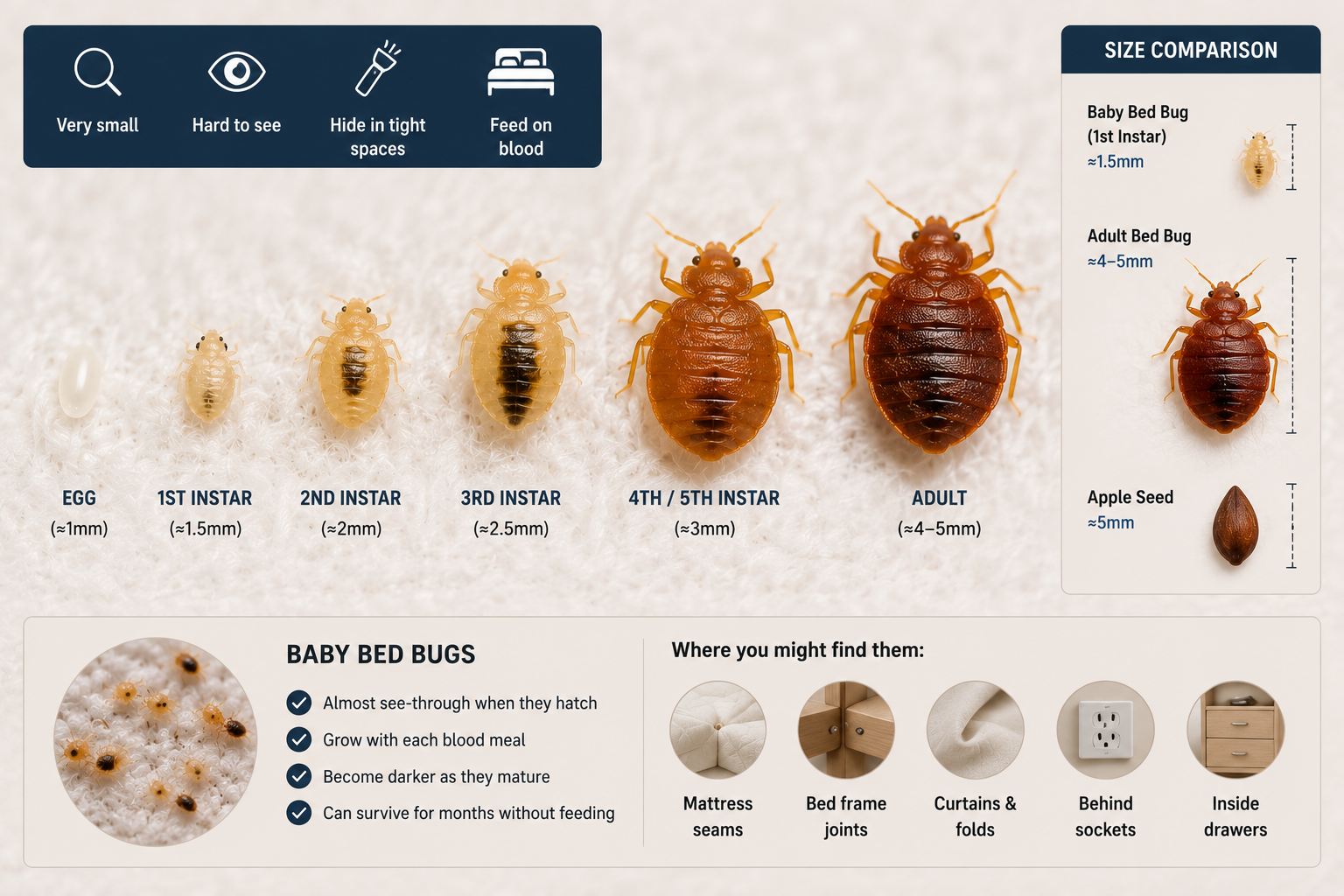
A newly hatched bed bug, known as a nymph, is only about 1.5 millimetres long. That’s roughly the size of a sesame seed.
Because they’re so small, most people don’t notice them until they’ve had a blood meal.
What colour are baby bed bugs?
Before they’ve fed, they’re almost translucent.
Their bodies are a pale cream or straw colour, which means they blend in with light-coloured mattresses, bedding and wooden furniture. I’ve had customers tell me they’ve inspected the bed several times without seeing anything, only to spot them immediately once I shine a torch across the surface at an angle.
After feeding, they’re much easier to spot.
Their abdomen fills with blood and changes to a bright red colour before gradually turning darker as the blood is digested.
That’s often the moment people first realise they’ve got bed bugs living in the room.
How are they different from adult bed bugs?
The shape is almost identical.
Baby bed bugs have the same flat, oval body as adults. They have six legs, two antennae and no wings.
The main differences are their size and colour.
Adults are broader, darker and much easier to see. Young nymphs are lighter, smaller and can almost disappear against certain surfaces.
Where I’d expect to find them
If there are baby bed bugs, there are almost always adults nearby.
I don’t go looking for nymphs first. I look for the places where bed bugs hide as a group.
That usually means checking:
- Mattress seams.
- Behind the headboard.
- Bed frame joints.
- Under labels on the mattress.
- Bedside furniture.
- Cracks and gaps close to the bed.
If I find one young bed bug on its own, I keep searching. Bed bugs don’t usually live in isolation.
What people confuse them with
Small insects cause a lot of unnecessary worry.
I’ve seen people mistake all sorts of things for baby bed bugs, including:
- Booklice.
- Carpet beetle larvae.
- Fleas.
- Spider beetles.
- Tiny ants.
The quickest way to make a mistake is to identify an insect based on size alone.
I always look at the shape, colour, location and any other evidence before deciding what I’m dealing with.
Can you see them without a magnifying glass?
Yes, but it isn’t always easy.
Good lighting makes far more difference than expensive equipment.
One trick I use is to hold a bright torch almost parallel to the mattress instead of pointing it straight down. The low angle creates shadows that make tiny insects stand out much more clearly.
It’s a simple technique, but it often reveals things you’d otherwise miss.
My advice
Don’t go hunting for one tiny insect.
Inspect the whole sleeping area instead.
If you’ve genuinely got bed bugs, there will usually be more than one sign. You might find droppings, cast skins, eggs or adult bed bugs in the same area.
The more pieces of evidence you have, the more confident you can be in your conclusion.
Bug Blitz by Destrodent provides professional bed bug heat treatment across the whole of Surrey, including Guildford, Woking, Farnham, Reigate, Camberley, Weybridge, Dorking, Cobham, Esher, Walton-on-Thames, Hersham, Epsom, and Redhill. Get in touch today for a free, no-obligation quote.